Contemporary Hominin — Wenfei Quan
TaThaTa presents Contemporary Hominin, a solo exhibition by Wenfei Quan.
The exhibition begins with a sense of displacement: the feeling of finding oneself, like a prehistoric human thrown into the contemporary world, surrounded by systems, technologies, and forms of relation one could never fully understand. For Quan, that feeling sharpens within the ecological and technological crises of the Anthropocene, and sharper still with the arrival of artificial intelligence. She imagines our encounter with AI as something like a prehistoric human meeting a modern electrical device: able to recognize the tool, perhaps even to use it, without grasping the knowledge, infrastructure, and history that made it. The “contemporary hominin” is not an ancient human transported into the present — it is the contemporary human seen again as a strange creature, set within a much longer evolutionary history and suddenly faced with technologies whose consequences no one can yet measure.
Symmetry gives this displacement a form. There is a persistent human wish to produce the world in our own image, to make what lies outside us legible through resemblance — but the symmetry keeps failing. A similar logic runs through the circulation of images online, where pictures are copied, compressed, recombined, generated, and returned in altered forms, spreading almost like organisms through repetition and mutation.
Printmaking gives Quan both a material process and a way of thinking through these relations. Reversal, transfer, doubling, repetition, and variation let an image stay tied to what came before it while turning into something else. Throughout Contemporary Hominin, this logic extends across prints, photographs, moving image, and installation.
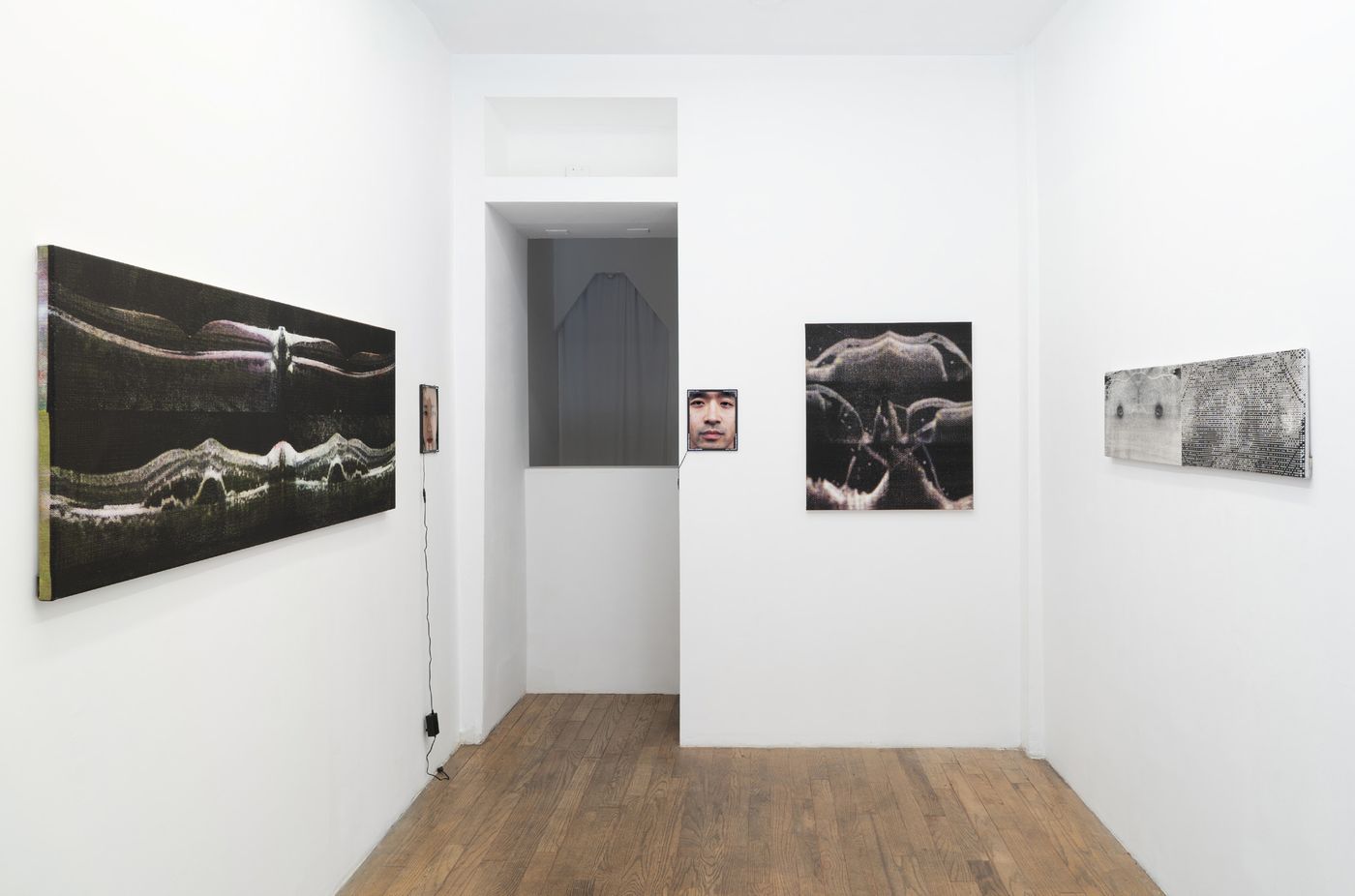
The exhibition’s titular installation, Contemporary Hominin, brings an AI-generated persona into the gallery. Its face is printed on transparent film and placed in front of a video device showing two rotating globes. Looking into the figure’s eyes, the viewer also looks through them, toward the worlds turning on the screen behind — the artificial hominin becomes at once something observed and a device for looking.
In the photographic series Mole, Quan begins with the naturally occurring moles on each sitter’s face and uses makeup to add corresponding marks on the opposite side before photographing them. The intervention is slight, yet the resulting faces turn subtly uncanny: recognizably individual and human while appearing, at the same time, strangely constructed.
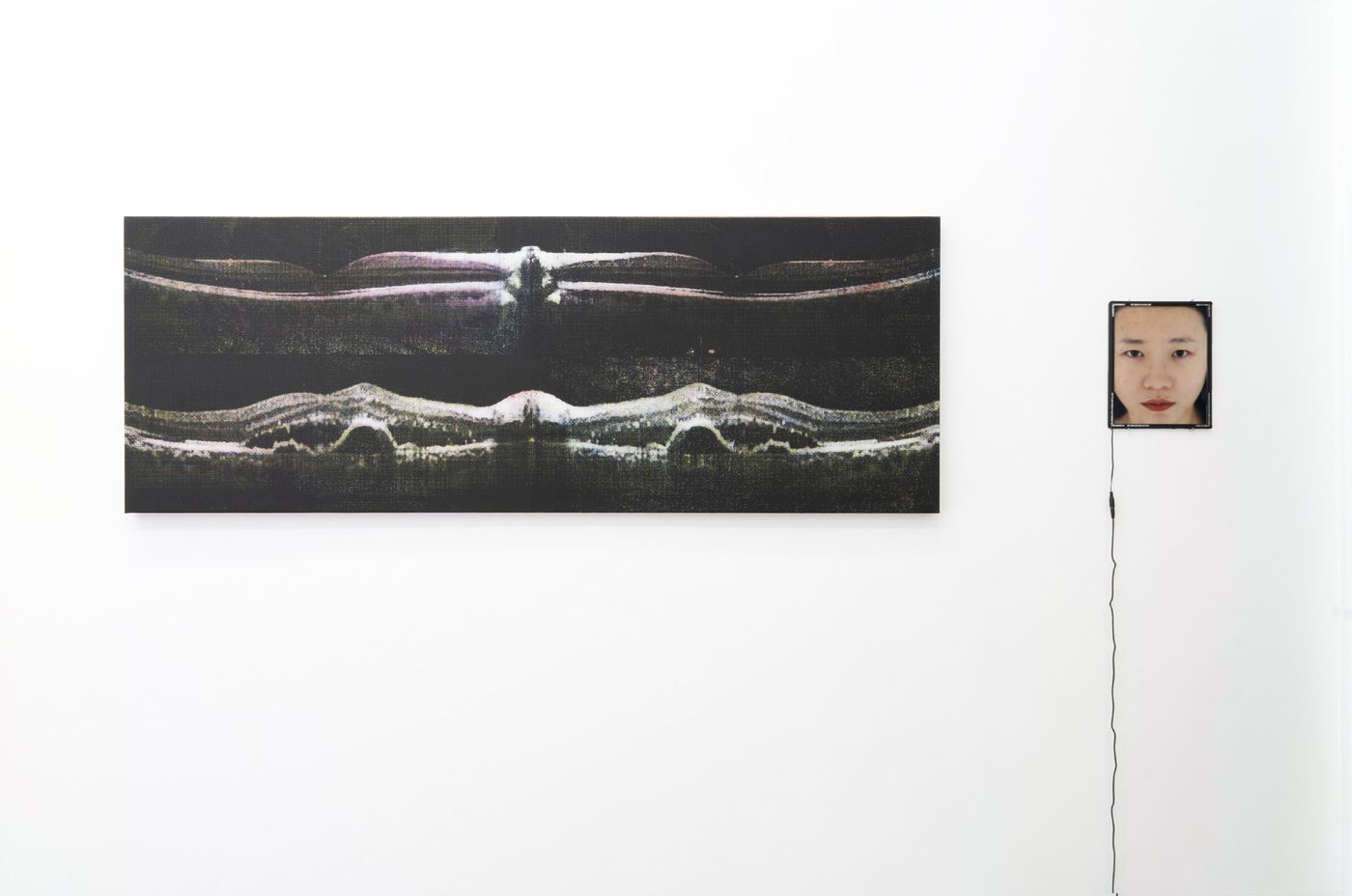
A new series of prints, Familiar Aliens, begins with color fundus photographs of the artist’s own eyes. Through the slight mirroring and repetition native to printmaking, the images slowly lose their anatomical certainty: retinal structures come to resemble faces, animals, cells, planetary surfaces, or unfamiliar organisms with a life of their own.
Across these works, symmetry is never a matter of things matching. Quan imposes a symmetry — a matched mole, a mirrored retina, a face that answers your gaze — precisely so that something fails to line up, so that the almost-right turns quietly suspicious and the familiar begins to look made.
About the artist. Wenfei Quan (b. 1992, China) is a conceptual artist and self-described “internet archaeologist” based in New York, with an MFA in Printmaking from Columbia University School of the Arts. Treating the internet as an emerging archaeological site of contemporary civilization, she excavates and reconstructs digital traces through printmaking, sculpture, installation, and moving image. Her work has been featured in The New York Times and shown at Inside-Out Art Museum, Beijing; LATITUDE Gallery, New York; the Miriam and Ira D. Wallach Art Gallery, New York; and Peninsula Art Museum, Shanghai.
Installation Views


Artists
Events
Your Notes
Record your impressions