
Seeing in Blue — Torkwase Dyson
Seeing in Blue spotlights a new series of paintings inspired by Dyson’s expeditions and sensory experiences as a deep-sea diver, exploring questions of distance, light, perception, symbiosis, and planetary transformation. The distilled works are informed by a culmination of haptic memories, diagrammatic drawings, engineering notes, photo journal entries, and process poems written by the artist during these explorations. Dyson brings her ongoing interest in the transhistorical implications of ecology, black geography, and built environments to an intimate scale, offering detailed expressions from her embodied research practices of oceanic infrastructure. Water is a central force of ancestral knowledge and global politics for the artist, and she offers a poetic look into the liminal space between its atmospheric phenomena and the complex infrastructures humanity has built that traverse above and below sea level.
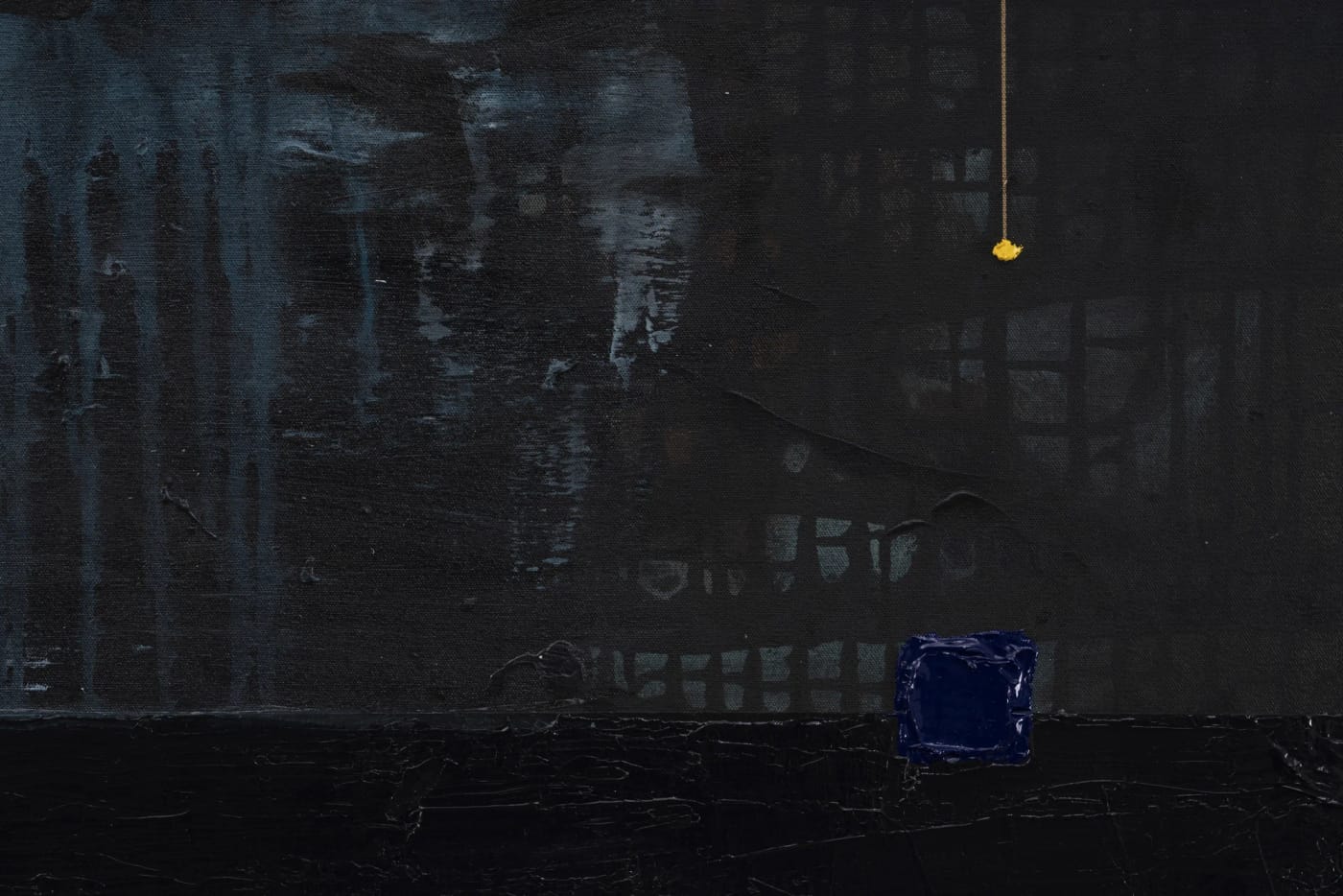
Dyson begins her painting process on the floor, priming the canvas with atmospheric washes of translucent colors that pool and layer in accordance with their inherent “discursive harmony.” From there, she moves toward detailed geometric constructions, building her signature curvilinear forms both in gestures of drawing and in shaped wooden panels (sanded and painted over as she navigates the composition), strings, and hardware fixtures. The quiet tension that arises between the two modes of mark-making—images that emerge by chance and by delicate construction—gives depth and luminosity to space. The canvas edges, often telling of this layered process, are considered just as live as the other compositional and material elements of her paintings.
Whereas a darker palette typically prevails in Dyson’s past works—producing a stark contrast between the colorful bleeds across the edge and the painting’s reductive, meditative front—aquatic tones come to the fore in Seeing in Blue . In Interbeing Blue (2026), the mixture of titanium white renders the painting’s prominent blue hues almost incandescent, which are then countervailed and animated by flickers of dark green and passages of rust-red. As much as these paintings evoke a real sense of vision and sights underwater, Dyson considers them apertures that enable us to experience not what she sees but how she sees.
Dyson’s new cycle of paintings is informed by more than ten years of swimming and diving across the globe and foregrounds a desire to bring her “witnessing” as a diver to bear on the medium of painting. Although water is completely colorless, it mediates phenomena and contains embodied perception. The sensory experiences of its pressure and buoyancy are closely linked to our own breath, density, and navigational movements. For the artist, the awe commanded by this “beauty of the below” is deeply physical, political, and infrastructural: over time, man-made objects, seafloor drill factories, artificial reefs, military posts, and acoustic surveillance—alongside the destruction of the built world—meld into the ocean’s natural spheres. What is evoked here is not a simple “vacation beautiful” aesthetic, but a sense of beauty that feels prehistoric, consequential, terrifying, and vulnerable all at once.
About the artist
Torkwase Dyson describes herself as a painter working across multiple mediums to explore the continuity between ecology, infrastructure, and architecture. Examining the history and future of black spatial liberation strategies, Dyson’s abstract works grapple with the ways in which space is perceived and negotiated, particularly by black and brown bodies. The artist has distilled a vocabulary of poetic forms to address the spaciousness of freedom and question what type of climates are born out of world building.
Installation Views



Artists
Publications
Events
Your Notes
Record your impressions