Sep 10 – Oct 17, 2026 · Closed
Scott Kahn: Silent Night — Scott Kahn
David Zwirner is pleased to present an exhibition by Scott Kahn at the gallery’s 537 West 20th Street location in New York. Focusing on the artist’s singular landscapes—a genre that is central to his practice—the exhibition will bring together a significant group of new and recent paintings alongside works spanning the previous twenty-five years that explore Kahn’s most enduring motifs.
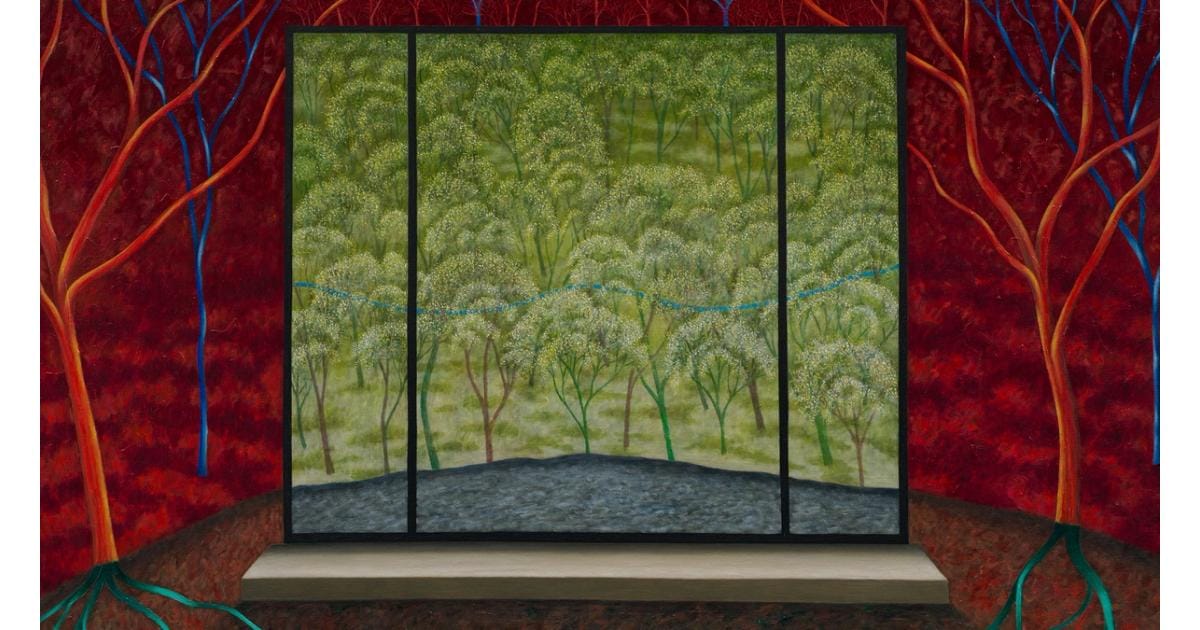
Over more than five decades, Kahn has maintained a commitment to a representational mode of expression, using a distinctive formal language to achieve a nuanced and poetic rendition of the simultaneous splendor and mundanity of the world around him. Rooted in his everyday life and experiences, Kahn’s enigmatic landscapes blend real and surreal elements. Many read as near facsimiles of lived experience shot through with electric color or ghostly shadows: billowing clouds that seem to come alive, ominous moonscapes, bare trees electrified by unexpected hues, and picture windows that open onto worlds both known and unknown. Seasons turn and day recedes into night, change often sweeping across a single canvas.
About the artist
 Scott Kahn
Rooted in the artist’s everyday life and experiences, American artist Scott Kahn ’s (b. 1946) enigmatic landscapes, portraits, and dreamscapes blend real and surreal elements. The artist has remained committed to a figurative mode of expression over the course of more than five decades, using a distinctive formal language to achieve a nuanced and poetic rendition of the simultaneous splendor and mundanity of the world around him. His surfaces are meticulously constructed according to precise geometries and chromatic and spatial relationships wherein the artist employs perspective and light to establish an illusory sense of depth that underscores the resonances imparted by the recurring cast of people, places, and symbols. Kahn’s works evidence his individual point of view while opening out onto universal themes, offering viewers a conduit through which to access a wide range of experiences and emotions.
Kahn was born in Springfield, Massachusetts, in 1946. He received a BA from the University of Pennsylvania, Philadelphia, in 1967. The following year, Kahn took classes at the Art Students League in New York, where he studied under the painter Theodoros Stamos and encountered other influential artists such as Mark Rothko, though he soon moved away from working in an abstract idiom in favor of the figurative style for which he has become known. Kahn subsequently completed an MFA at Rutgers University in New Brunswick, New Jersey, in 1970.
A seasoned painter who had been exhibiting steadily since the 1970s, Kahn began to garner widespread attention in 2018. That year, he made one very significant sale to his good friend and fellow painter Matthew Wong (1984–2019). Kahn and Wong had connected a few years prior via Facebook, where they bonded over their mutual artistic interests, eventually meeting in person and sharing their work. Wong posted Kahn’s painting Cul de Sac (2017) on his social media and praised Kahn as an important influence on his work, leading to increased public awareness of Kahn’s practice.
Events
Venue info
 David Zwirner
Website
Instagram
Hours
Open now · until 6PM
MonClosedTue10AM – 6PMWed10AM – 6PMThu10AM – 6PMFri10AM – 6PMSat10AM – 6PMSunClosed
Show page
Loading notes…