
KNOTTING, TYING, FOLDING — Lynda Benglis
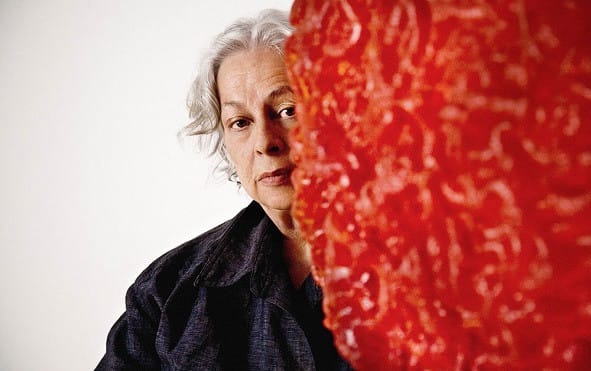
Since the late 1960s, Benglis has developed her lively, flowing forms across a wide range of materials—from beeswax, latex, and polyurethane foam to later innovations with plaster, gold, vaporized metals, glass, ceramics, and paper. Emerging amid the rise of Postminimalism, she set herself apart from her contemporaries with an enthusiastic embrace of vivid color and sensuous, organic surfaces. She has continuously pushed the boundaries of painting and sculpture over the course of her career, engaging in a radical investigation of sensorial perception.
KNOTTING, TYING, FOLDING will feature a robust range of sculptures created by Benglis over more than five decades, illuminating her use of diverse methods and materials. The earliest work in the show is Sparkle Knot IV (1972), a knotted tube of wire mesh covered in plaster, paints, and sparkles. Sparkle Knot IV signals the initiation of processes that Benglis would go on to transform and develop across further series also on view in Pace’s presentation, from the vibrant gold-leafed and metallized pleats and glass works of the 1980s, to the painterly, extruded and folded ceramics of the 2010s, all the way to her more recent Elephant Necklace and paper works, where knotting gives way to open, expansive forms.
“My involvement with surfacing of objects usually swings back and forth between extremes of coloration and texturing,” Benglis has said. “I always go from one pole to the other—it is one way of discovering things about the surface and color’s relationship to form.”
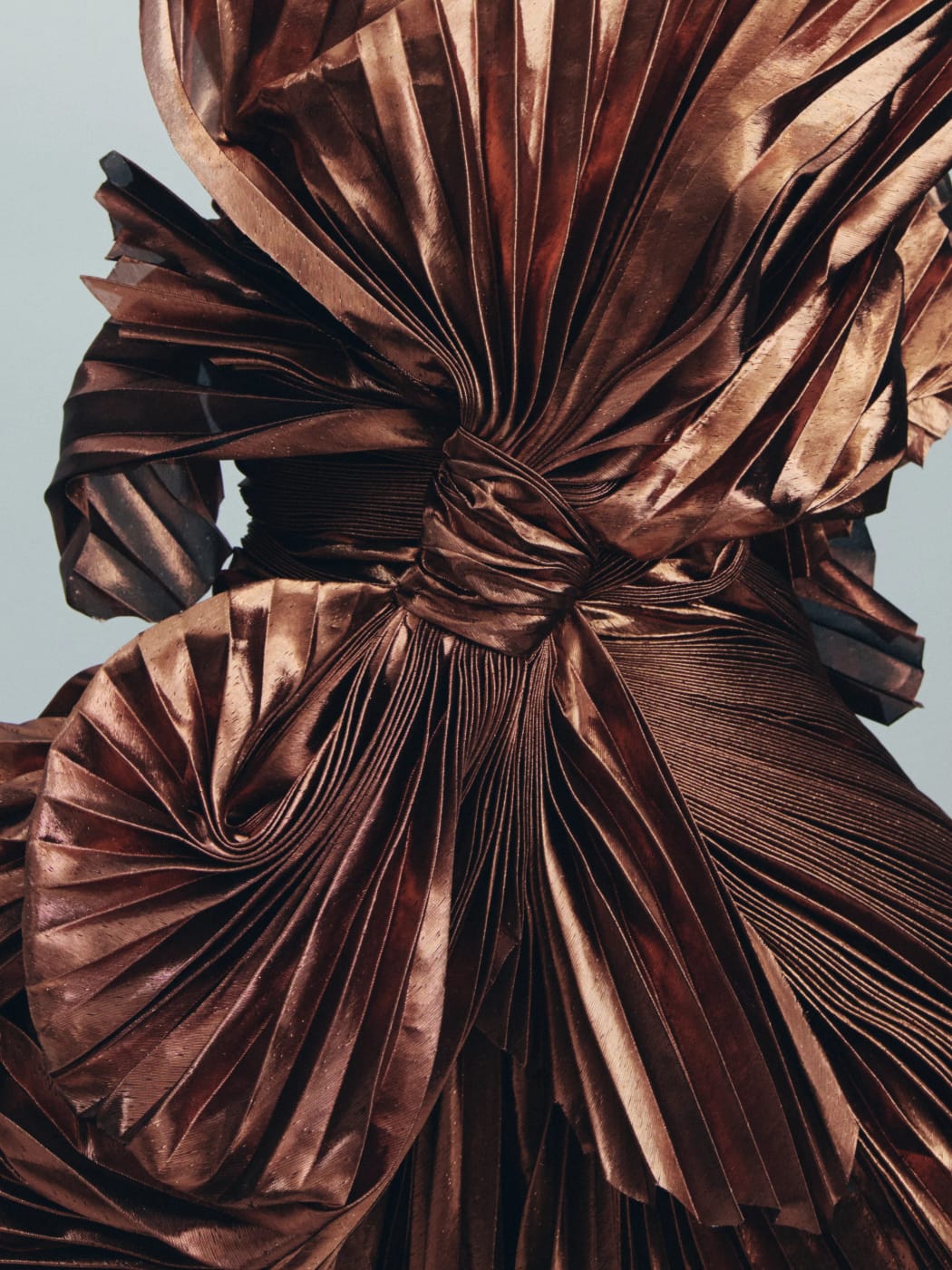
A selection of pleated wall-mounted sculptures from 1982 through 1990, in which “the light, and the change of light, was a goal,” in the artist’s words, will figure prominently in the exhibition. For these works, Benglis first took accordion-pleated wire mesh—a process she has likened to creating paper fans as a child—before knotting, tying, and twisting it into dynamic configurations that were then covered in plaster and gold leaf or, later, sprayed with vaporized metal. The wall-mounted works continue with a selection of paper sculptures from 2016 through 2020, which are composed of chicken wire covered with handmade paper that may be painted or saturated with sparkles. “They’re objects made of wet paper that’s been stretched, like a skin, on wire that I’ve contoured,” Benglis has explained. “I make marks on the paper of various sizes, densities, and characters. I realized that I make drawings the way I do because I see a surface as being spatial.”
A group of lesser-known sand cast glass works from 1985 will also feature in KNOTTING, TYING, FOLDING . For these unique sculptures, Benglis laid colorful glass shards, enamel eyes, and pigment-like powdered glass inside a shape molded in sand, into which she poured molten black or clear glass. Using Kevlar gloves and sticks, she then handled the molten glass in a highly physical process that she has called “a play-dance activity,” bending and tying it into knots. The resulting works are playful and abstract, gesturing toward both living beings—as indicated by titles like Desert Pupfish and Gila Top Minnow —and celestial bodies, with flecks of luminescent color on black ground.
Other free-standing sculptures in the exhibition include large-scale, reflective bronze works from recent years, in which rounded organic shapes seem to undulate and shift as viewers move around them, as well as small ceramic works from the 2010s, with Benglis’s signature folds, loops, and cascades embellished with expressionistic swathes of glaze. “The ceramics, for me,” Benglis said, “were about how to make gestures, an architecture of gestures, and how to make a painting physically—how to present it so that they're coming together and you have a kind of explosion or implosion of forms.”
About the artist
Since the 1960s, Lynda Benglis has been celebrated for her fearless exploration of forms, which are simultaneously playful and visceral, organic and, abstract. Benglis began her career in the midst of the Postminimal movement, pushing the traditions of painting and sculpture into new territories. She initiated several bodies of work in the late ’60s and early ’70s that set the course for her subsequent practice. Her wax paintings, which began with brushed skin-like layers of pigmented beeswax and dammar resin progressed, in one series, to the use of a blowtorch as a kind of brush, manipulating colors into a marbleized surface that fought against the constraints of the lozenge-shaped Masonite panels. The impulse to see these forms flow beyond the structure of a traditional support led Benglis to embrace pigmented latex, which she began pouring directly onto the floor. The use of gravity and her body in the latex pours invoked Jackson Pollock’s process, a connection immortalized in the February 27, 1970 issue of Life magazine, which featured Benglis at work.
Concurrently, she began working with pigmented polyurethane foam, building the volume of her sculptures vertically by pouring the oozing, lava-like forms against walls and in the corners of spaces or over constructed armatures and chicken wire, which she removed after the wall mounted foam pours solidified. Benglis’s totem-like sculptures followed as long, cylindrical structures made of wire mesh, cotton bunting, and plaster that, by 1972, she began to tie into knots. Painted with metallic sparkle, Sculp-Metal, or sprayed with layers of vaporized aluminum, copper, zinc, or tin, the works conflate the sculptural object with painterly space and translate the formal idea of "push and pull" into muscular, physical terms. Her gold sculptures of the '70s and early '80s return to the idea of the plane through forms that pinch into torso-like reliefs as well as through pleats that are rendered in reflective skins of gold over plaster and wire mesh.
In the early ’70s, Benglis took new media technologies as her material, producing video art at a time when it was still in its early stages as a medium. Her experimental videos feature performative actions and technological mediation to explore themes of physical presence, narcissism, sexuality, and gendered identity. Physical and Psychological Moments in Time , a retrospective of video works by Benglis, was held in 1975 by Fine Arts Center Gallery, State University of New York College at Oneonta, and subsequently traveled to Stedelijk Van Abbemuseum, Eindhoven, Netherlands. Benglis also introduced images of herself into the public discourse through a 1974 artwork placed as an advertisement in Artforum, which challenged assumptions about self-presentation and gender in a male-dominated art world.
Installation Views


Artists
Events
Your Notes
Record your impressions