Nov 6, 2026 – Jan 9, 2027
Gareth Cadwallader: Goodnight Moon — Gareth Cadwallader
Closed · opens 11AM
GRIMMGRIMM is pleased to present Goodnight Moon, a solo exhibition of paintings by Gareth Cadwallader, on view at the New York gallery from November 6, 2026 to January 9, 2027.
‘Then dearest child mournest thou only for Jupiter?
Considerest though alone the burial of the stars?’
- Walt Whitman, On the Beach at Night, c. 1856
Margaret Wise Brown's children's story Goodnight Moon (1947) is less a book than a ritual, complete with chanted incantation. Offered as a source of comfort, its pages populated with softness and warmth, it nevertheless portrays a world in which adults and children face the kingdom of the night apart from one another. The scene it describes is a transitional one, in which a child acquires the skills necessary for an acceptance of darkness and solitude.
There is no parent within the pages of Goodnight Moon, and the litany recited from it acknowledges a child's nocturnal fears. A pictureless page reads: ‘goodnight nobody’. The closing line is addressed to noises everywhere.’ Read askew, Goodnight Moon threatens to disintegrate into a horror story of parental abandonment, recounting the evidence of absence that is amplified by night.
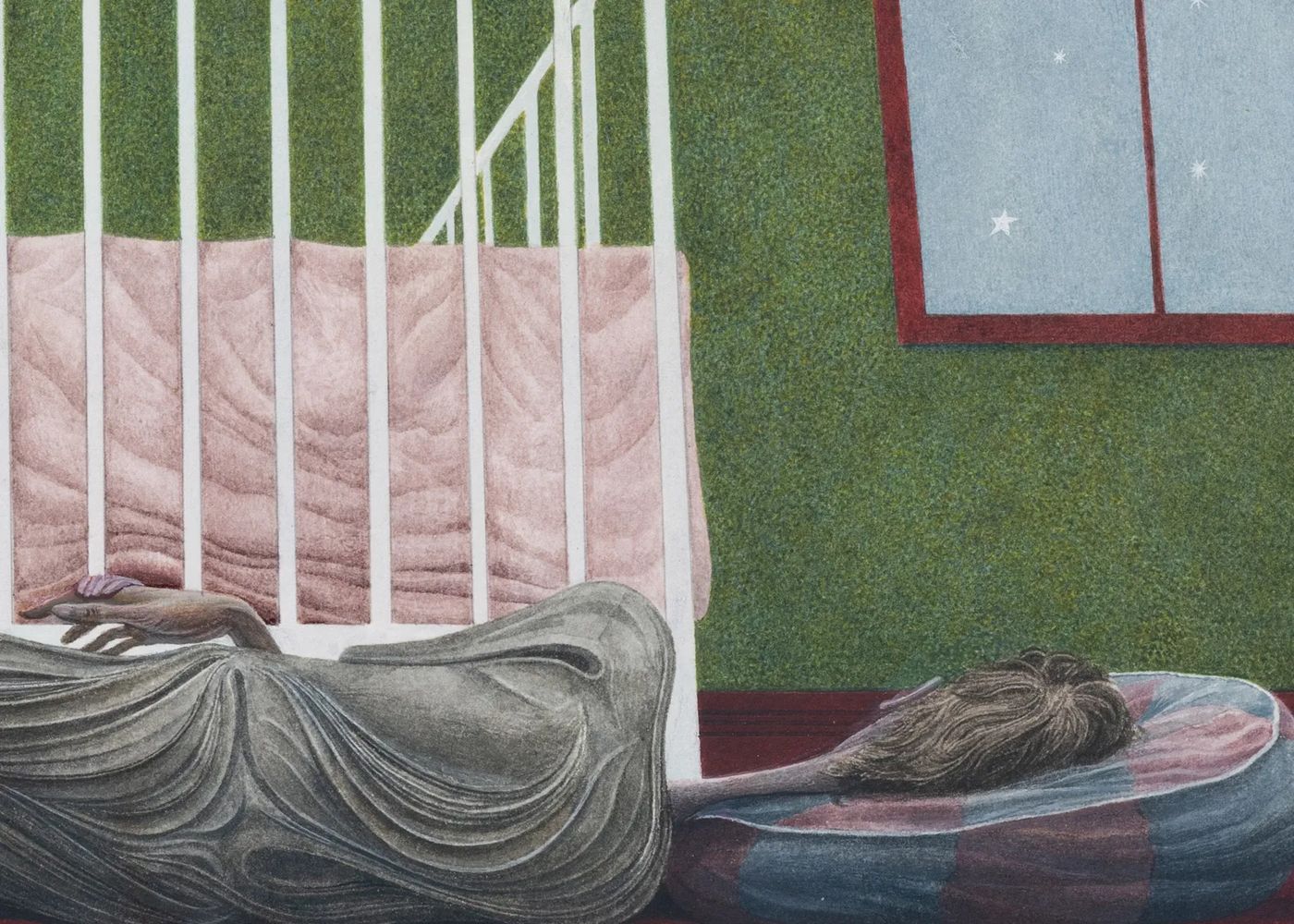
Gareth Cadwallader has borrowed the title Goodnight Moon for a pivotal painting in a new sequence of watercolours. Each of them composed in a small, elongated landscape format, similar in dimension to Illustrations in Japanese handscrolls. Like a picture book, this is a storytelling format. While nothing as easily accessed as a narrative binds these works, they carry a progression of ideas and experiences. Across nine panels, the series moves between death and life, and a transition between an identity as a son and that of a father.
Ashes (2024) positions us on a high ridge looking over a gentle rural landscape. A neat pair of hands emerges, tiny, at the lower right, tipping a cylinder which releases a cascade of something pale and light. Air currents lift this light material, dispersing it in a dancing cloud of greenish-blue particles. At its heart this tumbling cloud carries the figure of a man, his eyes closed, his face slack, his thin hands clasped around his bedsheets. The figure in the cloud is recognisably close to death. This is not an easy painting, but it whispers of transcendence: a bright scene, a domesticated landscape, an emblem of the human spirit carried up to meet the scuddling clouds.
This luminous scene of death and remembrance is followed, in Alice and Kaya (2022-25), by winter, and a body lying within the earth, held in the darkness like a fossil in sedimentary rock. This body is not dead, but waiting; not buried, but preparing to emerge. The periods that precede both birth and death can be curiously parallel. Each is a certainty but takes place in its own time. Or, perhaps, outside of time. To wait with someone in either state is to experience the flow of time suspended. Alice and Kaya offers the final stage of pregnancy as a geological event, with the mother body abstracted into a mystical sequence of modular forms and billowing volumes, like a costume from Oskar Schlemmer's Triadic Ballet. It is the mother who waits to emerge from the earth - her new identity born in the same instant as the baby. A nest of concentric circles hovers low above the ground beside the winter trees. Carved into the wall of a Medieval church it would be a protective emblem: here it is rendered in the cool metallic tones of a Hollywood spaceship, a thing of the future.
In Night Feed (2025-6) the mother body expands to become a protective nest, its strands glinting with a spectrum of improbable colors carried by the stippled midnight sky. The painting reflects an infant worldview, in which the baby's head and the rounded breast from which it feeds appear as twinned forms - two eggs occupying a nest formed by the mother who melds into the surrounding landscape.
Events
Venue info
 GRIMM
Instagram
Hours
Closed · opens 11AM
MonClosedTue11AM – 6PMWed11AM – 6PMThu11AM – 6PMFri11AM – 6PMSatClosedSunClosed
Loading notes…