Opening reception
Heitor dos Prazeres
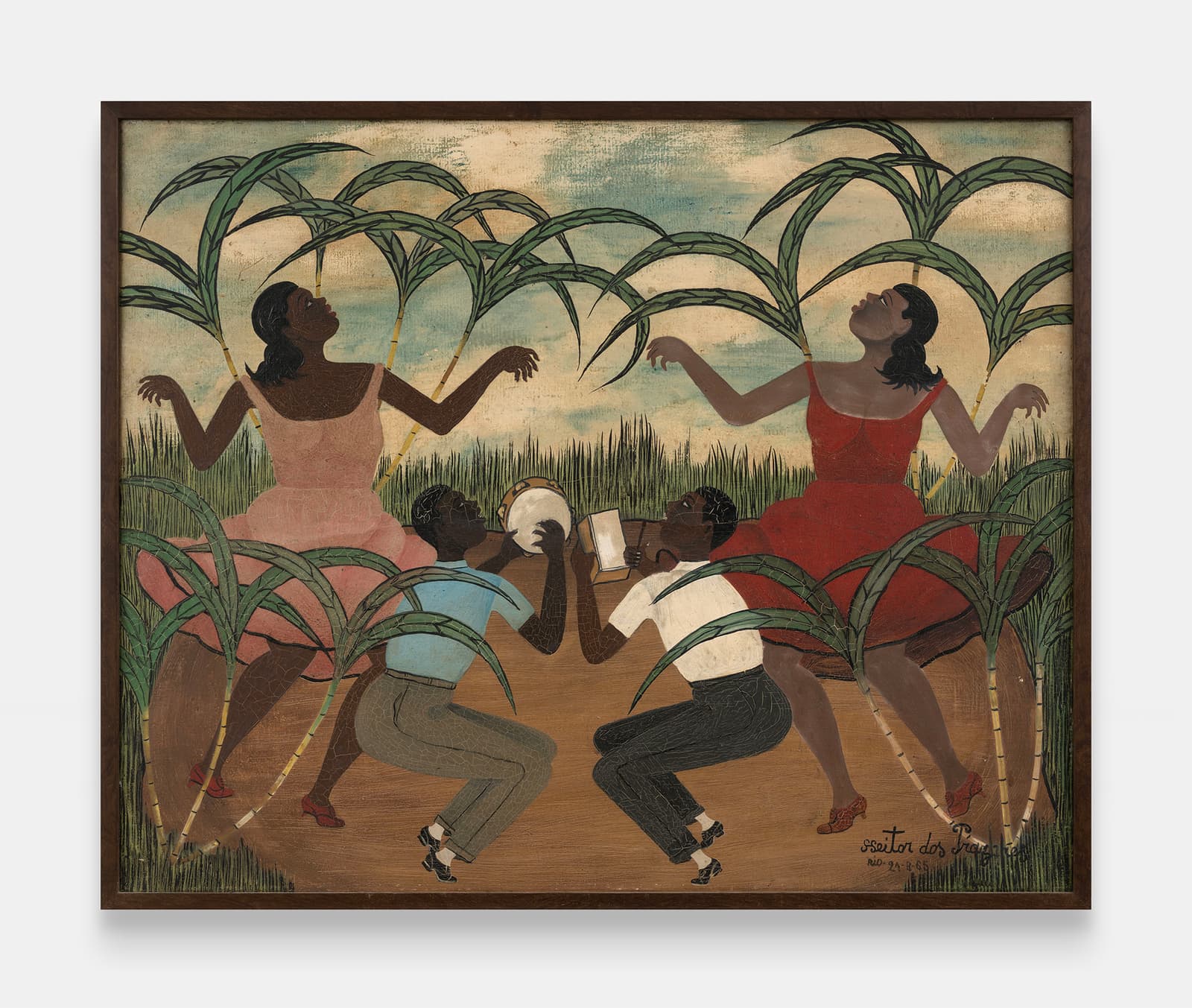
Andrew Kreps Gallery is pleased to announce an exhibition of works by Heitor dos Prazeres (b. 1898, Rio de Janeiro, d. 1966, Rio de Janeiro), a polymath whose contributions to the visual arts, fashion, and music established him as a key figure of samba and more broadly, the cultural landscape of Rio de Janeiro in the twentieth century. This is the first exhibition devoted to Prazeres’ work in New York, and includes works made between 1944 and 1966.
Born a decade after the abolition of slavery in Brazil, Heitor dos Prazeres was immersed in music from a young age, taught by both his father, and uncle, the musician Hilário Jovino Ferreira. Prazeres made his first musical compositions at the age of fourteen, and would soon after cement himself as a fixture of Rio de Janeiro’s “Pequena África” (Little Africa,) aiding in the establishment of now iconic samba schools, such as Deixa Falar, Mangueira, and Portela. This community greatly influenced Prazeres as he began painting in the mid-1930s, depicting scenes from Brazilian Black culture, from popular festivals, Afro-Brazilian religions, samba, and bohemian life. Vibrant in color and rhythmic in composition, Prazeres' paintings document not only scenes of joy, but also mourning, and suffering, inextricably tied to Prazeres’ experiences as a Black man, and a landscape marred by social inequity.
It was Prazeres’ persistent focus on the everyday that marked a radical shift from existing depictions of Black life in Brazil, which had been shaped by a colonial lens. While Prazeres paintings depict capoeira, samba, and affection, they also record police repression and the suppressed traditions of Afro-Brazilian religions, lending his practice an inherent political dimension. Using a singular visual language in which exuberant two-dimensional figures engage in energetic movement, Prazeres’s works were based in close observation of the people around him, as he aimed to maintain the dignity of his subjects in both form and spirit. Through portraying the reality of Pequena África and of Rio de Janeiro’s Black communities, Prazeres placed the socioeconomic reality of a post-abolition society at the forefront. As his profile grew within Brazil and internationally in the 1940s, with the Museum of Modern Art, New York acquiring a work in 1942, his paintings became a vital document of a dynamic, cultural community. This would lead Prazeres to later become one of the first victims of censorship in the days after Brazil’s civil-military coup of 1964, as he was dismissed from Rádio Nacional, where he had been a permanent cast member since 1943, by the newly installed dictatorship. While this dismissal proved a great blow to Prazeres, he remained resolute in creating visual art and music until his death two years later. Throughout his life, Prazeres had asserted that his work was inseparable from the place in which it was made, stating “The joy of these people, the suffering of these people is what compels me to work… These people are me, the man of the people.”
Venue info
 Andrew Kreps Gallery
Website
Hours
Open now · until 6PM
MonClosedTue10AM – 6PMWed10AM – 6PMThu10AM – 6PMFri10AM – 6PMSat10AM – 6PMSunClosed