Opening reception
Constance DeJong: Time's Wander
Constance DeJong wrote to me that “time is different kinds. . . light years and microns for example” and I would posit that they are different because our bodily selves are a rather inelastic measure. It is hard to expand, to become ethereal—and then to, in the next breath, be pulverized.
The cultural critic Rebecca Solnit wrote a very good book about Edweard Muybridge some years back in which she tells the story of how the railroad, and then the camera, collapsed our sense of space and time from the heliocentric to the mechanistic. This shoe might have been a size too small from the jump but the reduction was notably self-centering.
Robert Smithson was interested in his work as an artist being seen outside the frame of historical time, mise well clock time, so he invested in, and wrote about, geological time. He essentially laid a bigger map on top of the one that centered the human. He spoke in a language of artifacts, ruins, and landforms, imagining himself as a lost civilization of one.
DeJong is also exploring an expanded timeframe, but this new group of objects has more in common with art historian Kaja Silverman’s notion of the
photographer-as-receiver
—the act of picturing being one of attending to and amplifying the terms of time and space situating the subject—than with Smithson’s hubris.
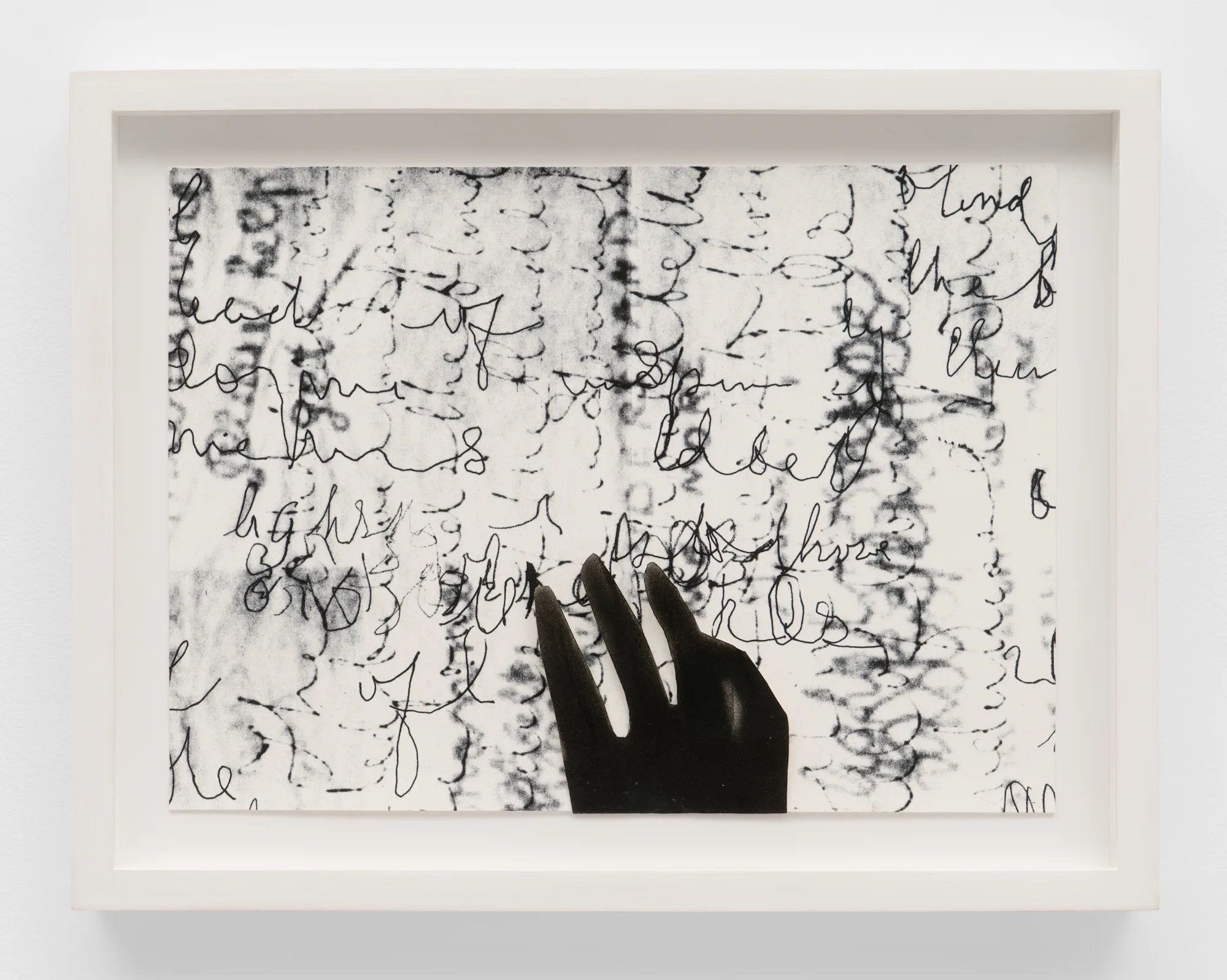
But she is not a photographer per se, though there is some photography involved. Instead of relying on the readily agreed upon—if somewhat truncated—reality the camera offers up, the works in this show picture a greatly expanded sense of the everyday: an air full of fields, particles, and wave forms, a nocturnal now inundated with the cosmic past, shadows drawn across time as well as space. But like photographs, they are units of observation. They resonate because they, like us, are a curious metric for romancing such an extraordinary expanse.
It is said that Spiritualism caught fire in the late 19th Century Euro-American psyche in part because the telegraph had recently been invented. This new technology not only made communication possible across great distances but also forced ordinary people to contend with the ways that its arrival redescribed the very terms of the world around them. And the fact that impossibilities were becoming actualities inevitably begot more occult curiosities. In any case, the air was full of energy, and they, in turn, were less the individuated beings they had known themselves to be than they were conductors entangled in great webs of forces in a world both far larger and far denser than it had been before. As DeJong’s pictures remind us, these realities still, a century later, have a habit of slipping from view. There is real pleasure, and real strangeness, in the way her work brings the vibrancy of matter clearly to mind.
—Lucas Blalock
Venue info
 Bureau
Website
Hours
Open now · until 6PM
MonClosedTue10AM – 6PMWed10AM – 6PMThu10AM – 6PMFri10AM – 6PMSat10AM – 6PMSunClosed