Opening reception
Joanne Robertson: Evening was blue
“I look at the world; I read and smell whatever the world is; and then I deform it. I modify it.”— Jacqueline de Jong For the Dutch artist, editor, and member of the Situationist International Jacqueline de Jong (1939–2024), observing the world was inseparable from the impulse to transform it. Immersing herself in her surroundings, de Jong absorbed and reinterpreted what she encountered, treating the world around her as both subject and material from which to invent new painterly forms.
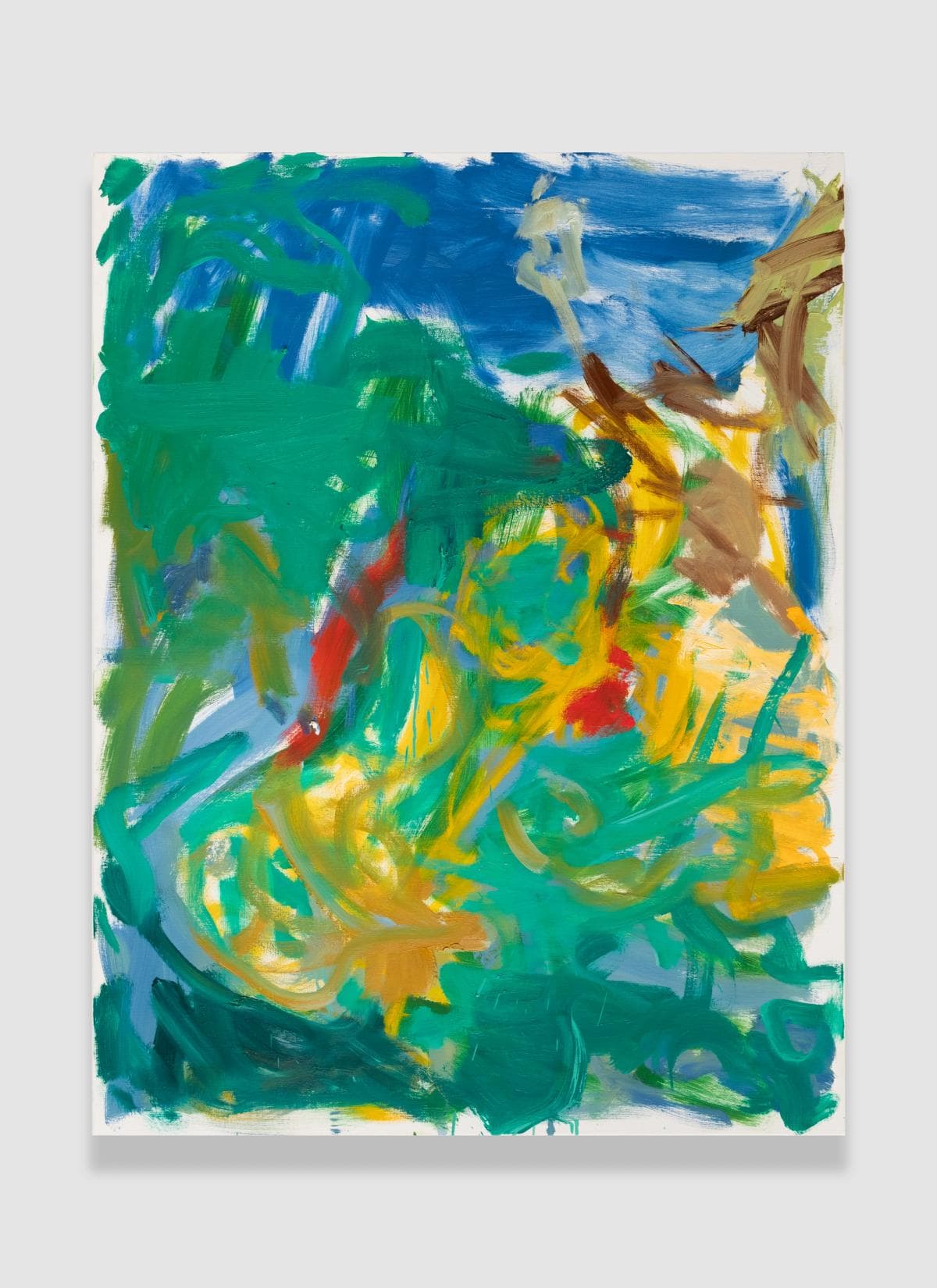
The practice of British, Glasgow-based painter, musician, and poet Joanne Robertson shares a similar sensibility, as it draws on the sensations and rhythms of everyday life. In dialogue with the history of painting, from Post-Impressionists such as Paul Cézanne to Abstract Expressionists such as Joan Mitchell, her works move fluidly between abstraction, landscape, and figuration. They resist self-representation, allowing familiar forms to dissolve, shift, and re-emerge through an intuitive interplay of color and gesture.
For her new solo exhibition at Company Gallery, Evening was blue, Robertson presents paintings and drawings all created during a residency in summer 2026, organized by the Jacqueline de Jong Foundation in the artist’s former country home and studio in rural central France. Known as Bouan, the property served as a place of retreat and artistic experimentation, where de Jong spent time each year, particularly during the summer months. It was here that she developed some of her most ambitious bodies of work, drawing on the surrounding environment as a source of artistic inspiration and formal exploration. These included several landscape paintings, as well as works inspired by the potato, which she cultivated in the house’s orchard, most notably the jewelry series Les Pommes de Jong, begun in 2008.
Produced in de Jong’s former studio, overlooking the orchard and neighboring fields, Robertson’s paintings bear traces of the landscape in which they were conceived. Titles such as Bouan Girl, Orchard Mail to You, and Lake Edith evoke this particular geography, locating the works within their immediate surroundings while opening them up to more elusive associations. As a songwriter and poet, Robertson brings a distinct sensitivity to language into her painting practice. Her titles often assume a concise, poetic quality, anchoring the works in particular places or experiences while suggesting meanings that extend beyond their immediate references.
The influence of the surrounding landscape extends beyond the titles to the paintings themselves, finding expression in a materiality and color palette that distinguish these works from Robertson’s previous works. Made during a period of severe drought, the paintings seem to absorb something of the ruggedness of the surrounding terrain. Their denser accumulation of paint and more assertive use of color—from rich, almost incandescent reds and deep, mossy greens to the muted golden yellows of parched fields—mark a departure from her typically looser, more gestural handling of paint and the pale, powdery pinks and soft lavender hues characteristic of her earlier work. This heightened engagement with paint and color also recalls de Jong’s earliest experiments with paint in the early 1960s, suggesting a subtle dialogue between the two artists taking place across time.
Yet Robertson’s paintings are never reducible to their immediate points of reference. However closely they may be rooted in a particular place or experience, language, form, and color continually exceed their origins, slipping away from familiar narratives and fixed meanings. Figures emerge only to dissolve into their surroundings; landscapes hover at the threshold of abstraction; their contours caught between representation and uncertainty. The exhibition’s title, Evening was blue, also encapsulates this subtle displacement of reality. An evening, ordinarily associated with the gathering darkness, is instead rendered blue, unsettling familiar perceptions through an unexpected chromatic association. Here, color becomes a way of distorting and reimagining what has been seen or felt. Painterly form brushes against meaning, grazing its surface without ever fully revealing itself.
Echoing de Jong’s conception of painting as an act of transformation, as a means of absorbing the world only to render it strange again, Robertson has forged a singular painterly language that recasts the familiar in ways that are unmistakably her own, carving out a distinct place within contemporary painting. - Juliette Desorgues
Venue info
 Company
Hours
Closed · opens 12PM
MonClosedTue12PM – 6PMWed12PM – 6PMThu12PM – 6PMFri12PM – 6PMSat12PM – 6PMSunClosed